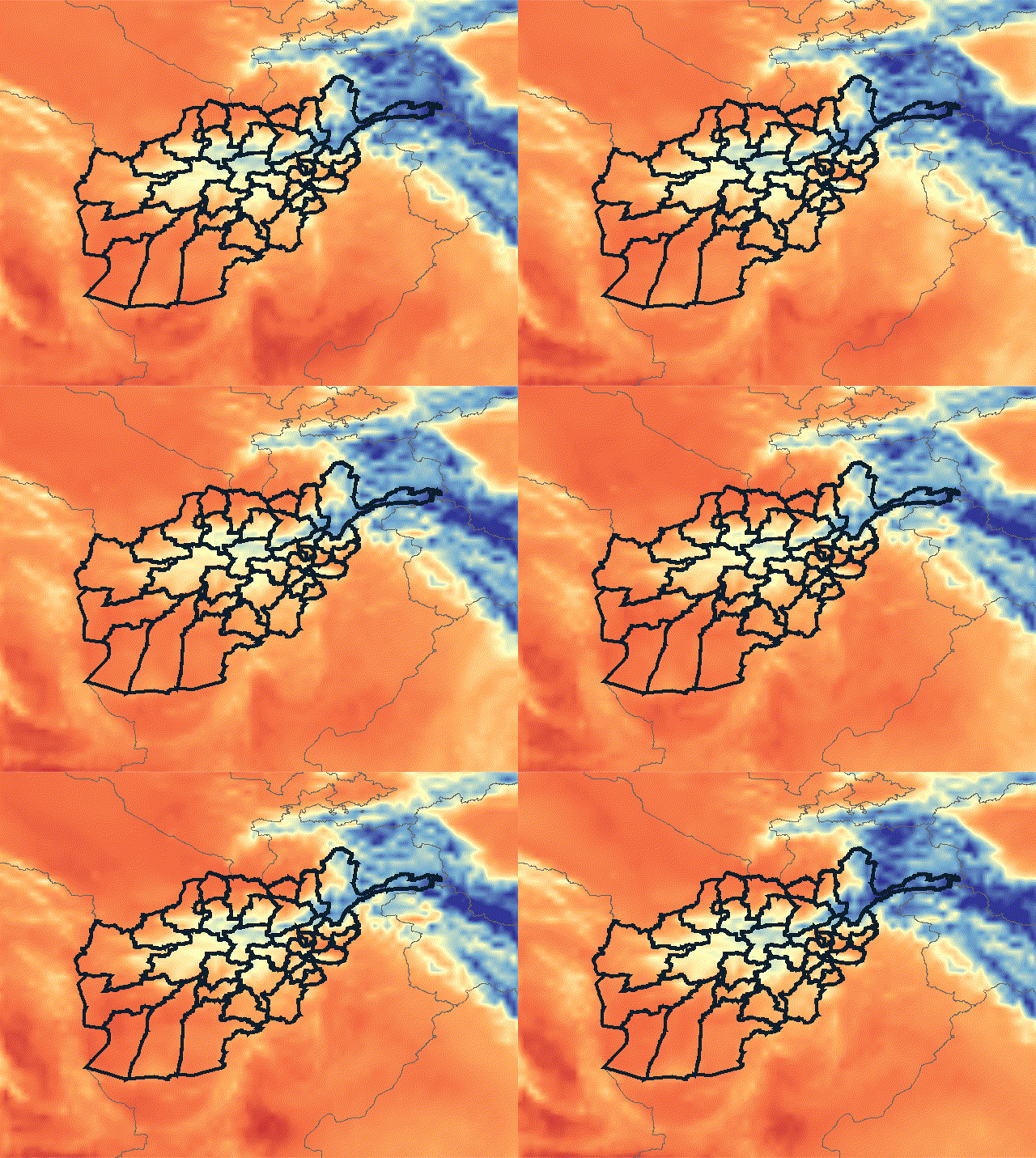
50 climate, drought, flood, and hazard indices — national, provincial, and district scale. Satellite data from 1950 to the present. Built for humanitarian practitioners, DRR specialists, and climate finance teams.
Where rain gauge networks are sparse, ground stations are absent, and field surveys are impossible — satellite intelligence fills the gap. Chashma-Sar provides free, authoritative, actionable data at national scale.
Where rain gauge networks are sparse, ground stations are absent, and field surveys are impossible — satellite intelligence fills the gap. Chashma-Sar provides free, authoritative, actionable data at national scale.
National overviews, 34-province zonal statistics, and 400+ district-level analysis. Export PNG maps, CSV tables, and GeoTIFF rasters for ArcGIS/QGIS.
Every index shows 4 tailored date presets anchored to its dataset's confirmed coverage — preventing empty-map errors on slow connections without any guesswork.
Province and district selection reduces tile loading 4–12×. Two-phase loading banner keeps users informed. Works on any modern browser — no installation.
Two types of layer: dynamic indices update with your date selection; static terrain layers are fixed and do not change with dates.
VHI below 40 = moderate drought; below 20 = extreme. AVI (Agricultural Vulnerability Index) combines NDVI anomaly, SPI, WSI, LST anomaly, and soil moisture — designed for food security targeting.
CHIRPS-based precipitation (1981–present). ERA5-Land temperature indices. SPI-3 < −2.0 = extreme drought. HeatIdx > 40°C = human health hazard — best used for summer months (Jun–Aug).
SeasonalFcst (GFS): 16-day precipitation forecast, best accuracy Days 1–7. ERA5 reanalysis: 1950–present, ~11 km — the only dataset covering 75 years. Ideal for long-term trend analysis and GCF/GEF evidence packages.
AHP composites combine 3–5 satellite datasets with peer-reviewed weights to produce 0–100 risk scores. FloodRiverAHP uses MERIT Hydro river proximity — includes all rivers (Helmand, Kabul, Arghandab). Use Quick Date presets to ensure all components have data.
MNDWI = near-real-time flood extent (MODIS, 500 m). Static terrain layers are proxy indices for relative risk planning — not certified hazard maps. Date selection does not affect static layers.
PET now uses ERA5-Land — covers all land surfaces including arid desert. ARI (Sentinel-5P): negative = clean air, positive = absorbing aerosol/dust. PDSI data ends December 2023.
PSC and SWE include elevation mask (500m+) to remove false snow signals from Sistan Basin salt flats. GWS_Anom (GRACE) shows groundwater trends at ~300 km resolution — regional use only.
Every index now shows 4 tailored date preset buttons in the Region tab. They update automatically when you switch indices — anchored to each dataset's last confirmed available date, so users on slow connections never get empty-map errors.
Compare vs PDSI (TerraClimate): presets automatically shift to 1 year · 3 years · 5 years · 20 years — anchored to the 2023-12 end date. GWS_Anom shifts to 3 months · 1 year · 3 years · 5 years anchored to Sep 2024.
No account required. No installation. Works on any browser including Chrome on Android and Safari on iPhone.
Click Launch Platform above or visit the URL. The platform loads directly — no login, no installation, no Google account needed.
Use the search bar (type 'vhi', 'flood', 'spi') or browse by category. Switch to the Region tab and click a Quick Date preset button.
Click "Show on Map". Phase 1 (amber) = server computing. Phase 2 (blue) = tiles streaming to your browser. On 256 kbps: 1–2 min for country, 20 sec for province.
Generate time series charts, compute province rankings, download PNG maps, copy CSV to Excel, or export GeoTIFF for ArcGIS/QGIS.
Chashma-Sar is open access to explore. Structured analysis, custom deliverables, and professional engagements — designed for INGOs, UN agencies, development banks, and companies — require a service contract.
Province-level drought, flood, or multi-hazard situation reports. VHI, SPI, WSDI province rankings with maps and trend charts. Ready for cluster submissions or donor briefs.
PDSI 20-year trend, groundwater depletion, desertification index, temperature time series — packaged as the "Climate Baseline" chapter for GCF, GEF, or LDCF proposals.
Index threshold design, alert logic, and integration with existing EWS workflows. MHDC province prioritisation for pre-positioning response. Protocol documentation included.
Bulk exports of any index for any province, district, or custom polygon. Delivered as GeoTIFF for ArcGIS/QGIS or CSV tables for Excel. Annual or multi-year time series available.
Drought, flood, and climate risk assessment for project sites or investment portfolios in Afghanistan. Suitable for ESRS, IFC Performance Standards, and ESG screening frameworks.
Co-authorship on Afghanistan climate studies. Platform co-citation. Published researcher (ACS ES&T Water, Q1, 2024). National Hazard Atlas of Afghanistan (2020) co-author.
Specialises in water resources, DRR, and satellite intelligence for Central Asia.
→ chashma-sar.comEnables planetary-scale satellite analysis without local hardware. Comparable capability to SERVIR / NASA FIRMS.
→ earthengine.google.comWater Resources & DRR Specialist. Published researcher (ACS ES&T Water Q1, 2024). GEE-certified practitioner.
→ b.rahmani@chashma-sar.comAfghan civil society organisation working on sustainable development, water, and DRR across 34 provinces.
→ mssado.orgWhere rain gauge networks are sparse, ground stations are absent, and field surveys are impossible — satellite intelligence fills the gap. Chashma-Sar provides free, authoritative, actionable data at national scale.
Four tabs · Search bar · Map toolbar · Two-phase loading banner · Quick Date Presets · About & Links footer
All 7 categories · Dynamic vs static · Sub-category descriptions · Data sources and coverage limits
Time series charts · Pixel charts · Province ranking · District statistics · Split view year comparison
PNG map images · CSV to Excel (step-by-step) · GeoTIFF for ArcGIS / QGIS
Food security & drought reports (WFP/FAO/OCHA) · Flood early warning · DRR priority assessment · GCF/GEF climate finance evidence
8 FAQ entries · Data availability table · Dataset limitations · Citation · Contact · Glossary (40+ terms)
Professional Registration Required for Access. Free, browser-based, no account needed — satellite intelligence for Afghanistan at your fingertips.